Grooming, Gossip, and the Evolution of Language by Robin Dunbar & Robin Ian MacDonald Dunbar
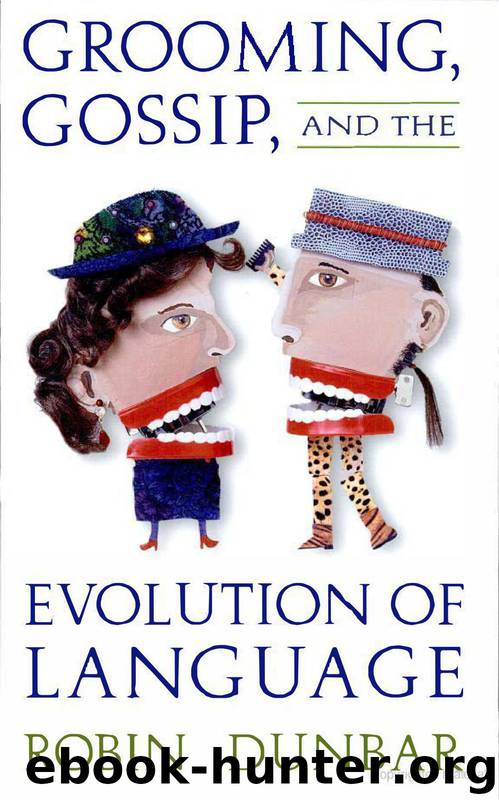
Author:Robin Dunbar & Robin Ian MacDonald Dunbar [Dunbar, Robin & Dunbar, Robin Ian MacDonald]
Language: eng
Format: epub
Tags: Language Arts & Disciplines, Linguistics, General, Science, Life Sciences, Evolution, Social Science, Anthropology, Cultural
ISBN: 9780674363366
Google: nN5DFNT-6ToC
Amazon: 0674363361
Publisher: Harvard University Press
Published: 1998-09-15T23:31:26+00:00
Grooming, Gossip and the Evolution of Language
Up Through the Mists of Time
larger and more widely distributed political and military power
to these kinds of problems as to predation risk. It is just the kind
base. Old habits, it seems, die hard - though in the latter case it is
of situation in which an arms race occurs: the raiders form bigger
worth reminding ourselves that all the parties involved
groups to raid more successfully, so you need to form even bigger
(Europeans, Americans and Australians alike) were the direct
groups to protect yourself, so the raiders need to form bigger
descendants of those ero-Magnon invaders from Africa.
groups still, and so on until ecological constraints impose a limit
We are left with one last puzzling question: what drove the
(perhaps in terms of the number of individuals that can be fed) .
increase in group size ? The short answer is, we don't know. But
A third possibility may stem from the fact that early i n the secwe can hazard some guesses. The conventional wisdom on priond phase of human evolution ( following the appearance of mates is that there are only two likely pressures that select for
Homo erectus two million years ago), a dramatic change in ecolarge group sizes: one is predation risk, the otqer the need to logical behaviour occurred: our ancestors became nomadic. They
defend food sources. But if baboons can cope with groups of
crossed the Arabian land bridge into Asia for the first time and
around 5 0, then it is difficult to see why the later humans and
within a few hundred thousand years had reached China and the
their immediate predecessors should have needed groups that
islands off the south-eastern coast of Asia.
were nearly three times bigger. The fact that they were larger than
Nomadism on this scale suggests that the groups foraged over
baboons (and carried passable defensive weapons in their hands)
large ranges, but were not afraid to step into the unknown beyond
should have meant that they could get by with smaller groups in . .
their everyday boundaries in search of new food sources. Animals
the same habitats. And indeed, this i s pretty much what you see.
face two problems in these situations. One is that they are unfamil
Baboons typically live in groups of 50 to 60 in woodland habitats,
iar with the lie of the land and don't know where the safe refuges
while hunter-gatherers in eastern and southern Africa typically
or the good feeding places are. The Swiss biologists Hans Sigg and
live in temporary camps of around 30 to 3 5 .
the late Alex Stolba showed that when the occasionally nomadic
Of course, our ancestors may have invaded even more open
hamadryas baboons are travelling outside their normal territory
habitats than those currently occupied by the woodland-based
they are significantly less likely to find water-holes and food trees
baboons and the forest-loving chimps, and so might have needed
than the groups resident in the areas concerned. The other is that
larger groups to offset the greater predation risk. Some evidence
resident groups may actively exclude them from access to such
to support this suggestion is provided by the modern gelada. This
essential resources (and
Download
This site does not store any files on its server. We only index and link to content provided by other sites. Please contact the content providers to delete copyright contents if any and email us, we'll remove relevant links or contents immediately.
Personalized inhaled bacteriophage therapy for treatment of multidrug-resistant Pseudomonas aeruginosa in cystic fibrosis by unknow(211869)
CONSORT 2025 statement: updated guideline for reporting randomized trials by unknow(102506)
Critical evaluation of the ProfiLER-02 study design and outcomes by Vivek Subbiah & Razelle Kurzrock(102034)
Cardiac gene therapy makes a comeback by Oliver J. Müller & Susanne Hille & Anca Kliesow Remes(101827)
Whisky: Malt Whiskies of Scotland (Collins Little Books) by dominic roskrow(74614)
Unveiling the design rules for tunable emission in graphene quantum dots: A high-throughput TDDFT and machine learning perspective by Şener Özönder & Mustafa Coşkun Özdemir & Caner Ünlü(50994)
A yeast-based oral therapeutic delivers immune checkpoint inhibitors to reduce intestinal tumor burden by unknow(40370)
Covalent hitchhikers guide proteins to the nucleus by Alexander F. Russell & Madeline F. Currie & Champak Chatterjee(40294)
Meet the Authors: Christopher R. Mansfield and Emily R. Derbyshire by Christopher R. Mansfield & Emily R. Derbyshire(40198)
Alkaline-earth metals promote propane dehydrogenation with carbon dioxide through geometric effects: Altering the reaction pathway by unknow(32811)
Induced iron vacancies boosting FeOOH loaded on sustainable Fenton-like collagen fiber membrane for efficient removal of emerging contaminants by unknow(32607)
Efficient electric-field-assisted photochemical conversion of methane to n-propanol exclusively over penetrated TiO2Ti hollow fibers by Guanghui Feng(32527)
Bi2SiO5 nanosheets as piezo-photocatalyst for efficient degradation of 2,4-Dichlorophenol by Hangyu Shi & Yifu Li & Lishan Zhang & Guoguan Liu & Qian Zhang & Xuan Ru & Shan Zhong(32463)
A novel NDIPTA organic heterojunction photocatalyst with built-in electric field for efficient hydrogen production by Jiahui Yang & Baojun Ma & Yongfa Zhu(32437)
Enhanced conversion of methane to liquid-phase oxygenates via hollow ferrite nanotube@horseradish peroxidase based photoenzymatic catalysis by Jun Duan & Shiying Fan & Xinyong Li & Shaomin Liu(32401)
Ordered macroporous superstructure of defective carbon adorned with tiny cobalt sulfide for selective electrocatalytic hydrogenation of cinnamaldehyde by Xiao-Shi Yuan & Sheng-Hua Zhou & San-Mei Wang & Wenbo Wei & Xiaofang Li & Xin-Tao Wu & Qi-Long Zhu(32330)
What's Done in Darkness by Kayla Perrin(27243)
Topological analysis of non-conjugated ethylene oxide cored dendrimers decorated with tetraphenylethylene: Insights from degree-based descriptors using the polynomial approach by A Theertha Nair & D Antony Xavier & Annmaria Baby & S Akhila(26627)
Investigation of mechanical and self-healing properties of hydroxyl-terminated polybutadiene functionalized with 2-ureido-4-pyrimidinone by Mohsen Kazazi & Mehran Hayaty & Ali Mousaviazar(26552)
